
Alcohol Is a Portal
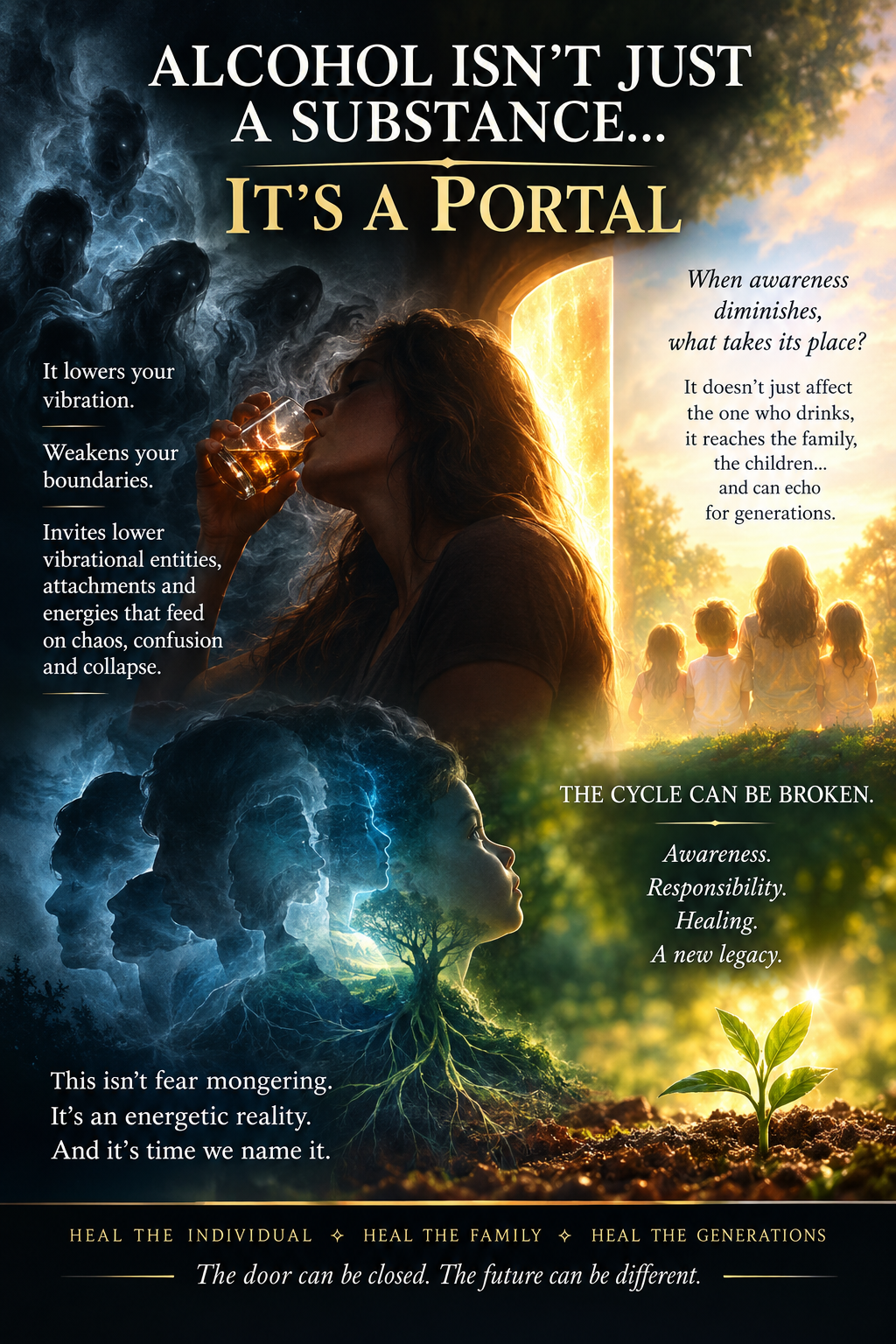
From a spiritual perspective, alcohol can be more than a means of numbing pain. When consumed excessively, it can become a doorway into states of diminished awareness, weakened discernment, and spiritual vulnerability.
When people drink to escape their pain, silence their emotions, or disconnect from themselves, they may unknowingly surrender the very awareness that helps them maintain healthy emotional, mental, and spiritual boundaries.
And when awareness diminishes, what takes its place?
In spiritual traditions, there is a longstanding understanding that our inner state influences the energies we entertain, the environments we create, and the influences to which we become receptive. Some traditions describe negative spiritual influences as lower-vibrational entities, attachments, or energies that thrive in chaos, confusion, fear, and despair.
Whether understood spiritually or psychologically, one truth remains: what weakens our awareness can also weaken our ability to protect our peace, exercise discernment, and remain connected to our highest selves.
There is a reason alcohol has long been associated with the word spirits. Although the word's history is rooted in the language of distillation and the essence extracted from a substance, its symbolism invites a deeper question: What happens to our own spirit when we repeatedly seek to escape our reality through intoxication?
WHEN CONSCIOUSNESS BECOMES CLOUDed
Heavy drinking can take a person into a state where judgment deteriorates, self-awareness fades, and the ability to make conscious choices becomes severely impaired.
An alcohol blackout is a particularly serious example. A person may appear awake, speak, walk, and interact with others while their brain is no longer properly forming memories. From a spiritual perspective, such profound disconnection from conscious awareness may be interpreted as a loss of energetic grounding or a weakening of one's spiritual boundaries.
It is important to distinguish spiritual interpretation from medical fact: a blackout does not establish that the soul has left the body or that another presence has entered it. Nevertheless, the physical, emotional, and spiritual consequences of repeated intoxication deserve serious attention.
When a person repeatedly loses control of their awareness, the effects rarely remain confined to that individual.
THE ENERGY OF ALCOHOL REACHES BEYOND THE DRINKER
Families feel the consequences. Partners carry the uncertainty. Children absorb the atmosphere.
A child living in a home where blackout drinking occurs may learn to anticipate anger, unpredictability, emotional absence, or sudden changes in behavior. Even when no one explains what is happening, children are often keenly aware that something is wrong.
They may grow up believing that chaos is normal, that love must be earned, or that they are somehow responsible for another person's pain. These experiences can influence their relationships, coping mechanisms, and sense of safety long into adulthood.
From a spiritual perspective, some may also understand these inherited patterns as energetic imprints that remain within a family system. What one generation leaves unresolved can become a burden the next generation is left to carry.
What is passed down is not always a possession. Sometimes it is a pattern. Sometimes it is a wound. Sometimes it is a way of living that no one has yet learned how to break.
And this is where the concept of generational curses becomes particularly meaningful.
Whether viewed through a spiritual lens or through the transmission of trauma, learned behaviors, and family beliefs, destructive patterns can repeat themselves across generations. But repetition is not destiny. What has been inherited can be recognized, addressed, and transformed.
THE CYCLE CAN BE BROKEN
Spiritual awareness calls us to examine not only what we consume, but also what we use to escape, what we tolerate, and what we allow to influence our lives.
Healing begins when we stop running from our pain and begin addressing its source. It deepens when we reclaim personal responsibility, restore healthy boundaries, seek appropriate support, and make conscious choices that honor our well-being and the well-being of those who depend on us.
For those who understand healing through a spiritual framework, prayer, meditation, spiritual discernment, and supportive spiritual practices may offer meaningful sources of strength. Professional treatment and recovery support can also be essential when alcohol use becomes difficult to control.
No one needs to live in shame. No family is destined to repeat the past. And no person should be made to believe that negative spiritual forces have condemned them or their children.
The greatest power is not in fearing what may enter through a doorway. It is in becoming conscious enough to recognize what is harming us, courageous enough to face it, and committed enough to close the door on destructive patterns.
Alcohol misuse can damage far more than the body. It can disrupt relationships, fracture trust, diminish self-awareness, and leave wounds that echo through generations.
The invitation is not to live in fear.
It is to awaken.
To reclaim our awareness.
To protect the peace of our homes.
To heal what has been carried for too long.
And to remember that the cycle can end with us.
Awareness opens the path. Responsibility changes the direction. Healing transforms the legacy.